
ROLE OF AI IN DIGITAL MARKETING 10 POWERFUL BENEFITS AND FOR BUSINESS GROWTH
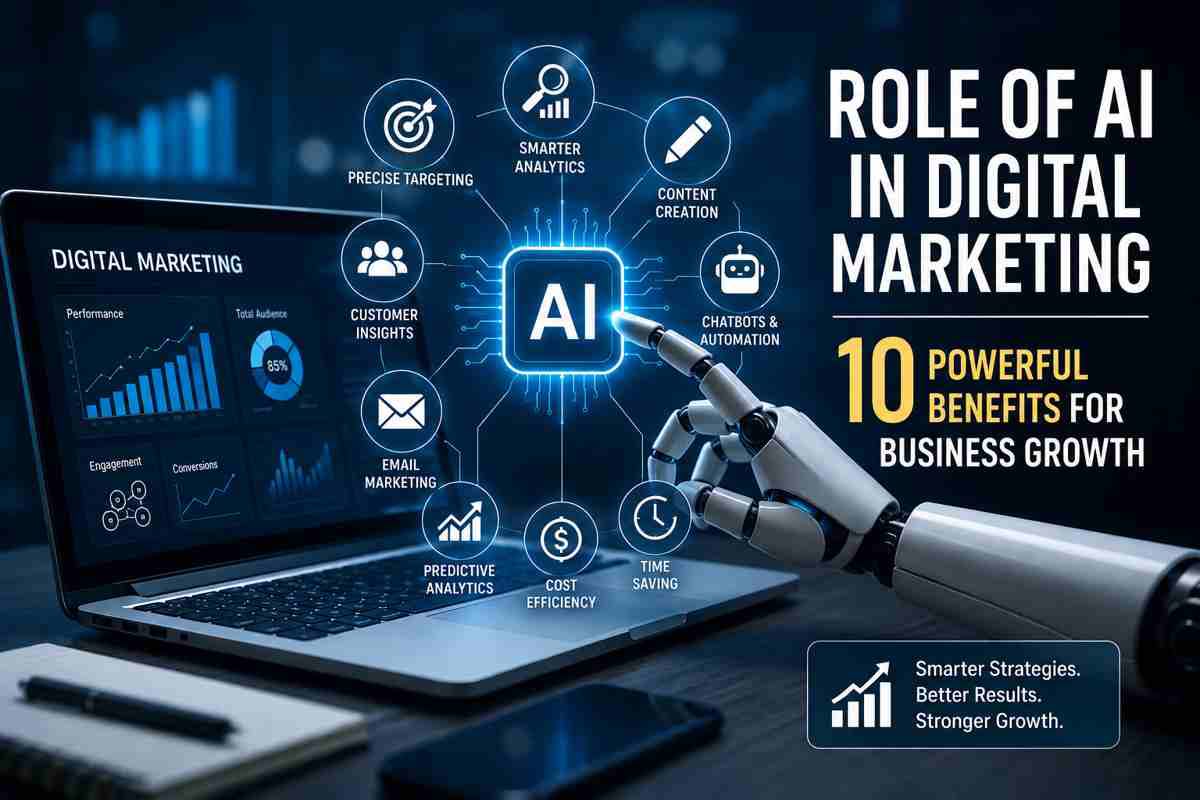
Discover the role of AI in digital marketing, its top benefits, and the best AI tools businesses use to improve customer experience, automate marketing, and boost sales.
Role of AI in Digital Marketing: Benefits and Tools
Introduction
Artificial Intelligence (AI) is transforming the way businesses connect with their customers online. Over the past few years, AI has become one of the most valuable technologies in digital marketing. From creating engaging content to analyzing customer behavior and automating repetitive tasks, AI helps businesses work smarter rather than harder.
Today, companies of all sizes use AI-powered tools to improve customer experiences, generate high-quality leads, and increase sales. Whether it is personalized product recommendations on an e-commerce website, AI chatbots answering customer questions, or automated email campaigns, AI has become an essential part of modern marketing strategies.
Understanding the Role of AI in Digital Marketing Benefits and Tools is important for marketers, entrepreneurs, and students who want to stay competitive in today’s digital world. AI not only saves time and reduces costs but also helps businesses make better decisions using real-time data and predictive analytics.
This article explains how AI is changing digital marketing, explores its major benefits, and introduces the most effective AI tools used by businesses around the world.
What is AI in Digital Marketing?
Artificial Intelligence in digital marketing refers to the use of intelligent computer systems and machine learning technologies to improve marketing activities. AI systems can analyze large amounts of customer data, identify patterns, predict customer behavior, and automate marketing tasks without constant human intervention.
Instead of relying only on manual efforts, marketers can use AI to make faster and more accurate decisions. AI helps businesses understand customer preferences, recommend suitable products, optimize advertising campaigns, and create personalized marketing experiences.
For example, when you shop online and receive product recommendations based on your previous purchases, AI is working behind the scenes. Similarly, when Netflix recommends movies or Spotify suggests songs based on your interests, AI algorithms analyze your behavior to deliver personalized content.
In digital marketing, AI is not replacing human marketers. Instead, it acts as a powerful assistant that improves productivity, enhances creativity, and provides valuable insights that help businesses achieve better marketing results.
Why AI is Important in Digital Marketing
Digital marketing has become highly competitive. Every business wants to attract more customers, improve engagement, and increase conversions. Managing all these tasks manually is difficult and time-consuming.
Artificial Intelligence solves this challenge by automating repetitive work and providing data-driven insights. AI helps marketers understand what customers want, when they are most likely to buy, and which marketing strategies produce the best results.
Some of the key reasons why AI has become important include:
Faster data analysis
Better customer understanding
Personalized marketing campaigns
Improved customer engagement
Reduced marketing costs
Higher return on investment (ROI)
More accurate decision-making
Better customer support through automation
As technology continues to evolve, AI will play an even bigger role in helping businesses achieve their marketing goals.
Role of AI in Digital Marketing
Artificial Intelligence is changing almost every aspect of digital marketing. Businesses now rely on AI to improve efficiency, increase customer satisfaction, and achieve better marketing performance. Below are the major roles AI plays in digital marketing.
1. Personalized Customer Experience
One of the biggest advantages of AI is personalization. Modern customers expect businesses to understand their preferences and provide relevant recommendations.
AI analyzes customer data such as browsing history, previous purchases, search behavior, and interests. Based on this information, businesses can recommend products and services that match each customer’s needs.
For example, an online clothing store may recommend similar products based on a customer’s previous purchases. This personalized experience increases customer satisfaction and improves conversion rates.
Personalization also helps businesses build stronger relationships with customers, leading to higher loyalty and repeat purchases.
2. AI-Powered Content Creation
Creating high-quality content consistently is one of the biggest challenges for digital marketers. AI simplifies this process by assisting with content creation.
Modern AI writing tools can generate:
Blog articles
Social media captions
Product descriptions
Email newsletters
Website content
Ad copy
Video scripts
Although AI speeds up content production, human editing is still important to maintain originality, accuracy, and brand voice.
By combining AI with human creativity, businesses can produce engaging content more efficiently while maintaining quality.
3. Chatbots and Virtual Assistants
Customer service plays a crucial role in digital marketing. AI-powered chatbots provide instant responses to customer questions at any time of the day.
Unlike human support teams that work during business hours, AI chatbots are available 24/7. They can answer frequently asked questions, recommend products, process orders, schedule appointments, and solve common customer issues.
Benefits of AI chatbots include:
Faster response times
Lower customer support costs
Improved customer satisfaction
Increased sales opportunities
Better user experience
Many businesses now use chatbots on websites, mobile applications, and social media platforms to improve customer engagement.
4. Predictive Analytics
AI can analyze historical customer data to predict future behavior. This process is known as predictive analytics.
Predictive analytics helps marketers understand:
Which customers are likely to purchase
Which products will become popular
When customers may stop buying
Which marketing campaigns will perform best
These insights allow businesses to make smarter marketing decisions before launching campaigns.
Instead of relying on guesswork, marketers can use AI-generated predictions to allocate budgets more effectively and improve campaign performance.
5. Search Engine Optimization (SEO)
AI has significantly improved Search Engine Optimization (SEO). Modern AI tools help marketers understand search intent, identify relevant keywords, optimize website content, and improve search rankings.
AI-powered SEO tools can:
Find high-ranking keywords
Analyze competitors
Optimize website structure
Improve readability
Suggest internal linking opportunities
Identify technical SEO issues
Businesses using AI for SEO can create more relevant content that matches user intent, increasing their chances of ranking higher on search engines.
6. AI in Social Media Marketing
Social media has become one of the most powerful digital marketing channels, but managing multiple platforms manually can be challenging. This is where Artificial Intelligence makes a significant difference.
AI helps marketers create better social media strategies by analyzing audience behavior, identifying trending topics, and recommending the best time to publish content. Instead of guessing what users want to see, AI uses data to understand customer interests and engagement patterns.
Many AI-powered tools also automate social media management by scheduling posts, responding to comments, and tracking campaign performance. Businesses can save valuable time while maintaining an active online presence.
For example, AI can identify which type of content—videos, images, or blog links—receives the highest engagement and recommend similar content for future campaigns. This improves audience interaction and increases brand awareness.
As competition on social media continues to grow, AI allows businesses to create smarter marketing strategies that deliver better results.
7. AI in Email Marketing
Email marketing remains one of the highest-performing digital marketing channels, and AI has made it even more effective.
Traditional email campaigns often send the same message to every subscriber. AI changes this by creating personalized email experiences based on customer behavior and preferences.
AI can:
Personalize email subject lines
Recommend products based on previous purchases
Send emails at the best time
Segment customers automatically
Predict which subscribers are most likely to respond
This level of personalization increases email open rates, click-through rates, and conversions while reducing the chances of emails being ignored.
Businesses can also use AI to automate follow-up emails, welcome messages, abandoned cart reminders, and promotional campaigns without manual effort.
8. AI in Digital Advertising
Online advertising has become increasingly competitive, making it important for businesses to target the right audience.
Artificial Intelligence improves digital advertising by analyzing customer data in real time. AI determines which audience is most likely to engage with an advertisement and automatically adjusts campaigns for better performance.
AI can optimize:
Google Ads campaigns
Social media advertisements
Display advertising
Video advertisements
Shopping campaigns
Instead of spending money on ineffective ads, businesses can use AI to maximize their advertising budget and improve Return on Investment (ROI).
AI continuously learns from campaign performance and automatically recommends improvements, making advertising smarter and more cost-effective.
Benefits of AI in Digital Marketing
Artificial Intelligence offers numerous advantages that help businesses improve their marketing performance while reducing manual work. Below are the major benefits of AI in digital marketing.
1. Better Customer Experience
AI helps businesses understand customer preferences and deliver personalized experiences. Customers receive relevant product recommendations, customized emails, and targeted advertisements that match their interests.
This personalization increases customer satisfaction and builds stronger relationships between businesses and consumers.
2. Time-Saving Automation
Many digital marketing tasks are repetitive and time-consuming. AI automates activities such as content scheduling, email marketing, customer support, and campaign monitoring.
As a result, marketers can focus more on strategy, creativity, and business growth instead of spending time on repetitive tasks.
3. Improved Decision-Making
AI processes large volumes of customer data within seconds. It identifies trends, customer behavior, and marketing opportunities that may not be visible through manual analysis.
These insights help businesses make smarter decisions and reduce marketing risks.
4. Higher Conversion Rates
By targeting the right audience with personalized content, AI increases the chances of converting visitors into customers.
AI also identifies potential customers who are most likely to purchase products, allowing businesses to focus their marketing efforts more effectively.
5. Cost Efficiency
Hiring large marketing teams can be expensive. AI automates many marketing processes, reducing operational costs while increasing productivity.
Businesses can achieve better results without significantly increasing their marketing budget.
6. Better Customer Support
AI-powered chatbots provide instant support at any time of the day. Customers no longer have to wait for business hours to receive answers to common questions.
Fast customer support improves satisfaction and increases trust in the brand.
7. Accurate Data Analysis
Modern businesses collect massive amounts of customer information every day.
AI analyzes this data quickly and accurately, helping marketers understand customer preferences, purchasing behavior, and market trends.
This data-driven approach leads to better marketing strategies.
8. Increased Productivity
AI tools perform repetitive tasks much faster than humans. Marketing teams become more productive because they spend less time on manual activities and more time on creative planning.
Improved productivity allows businesses to launch campaigns more quickly and respond to market changes efficiently.
Top AI Tools for Digital Marketing
Choosing the right AI tools is essential for successful digital marketing. Below are some of the most popular AI-powered tools used by marketers worldwide.
1. ChatGPT
ChatGPT helps businesses generate blog articles, social media posts, product descriptions, email campaigns, FAQs, and customer support responses.
It saves time while improving content quality.
2. Canva AI
Canva AI simplifies graphic design by creating professional-quality images, presentations, social media graphics, and marketing materials.
Even beginners can create attractive visual content without advanced design skills.
3. Google Analytics
Google Analytics uses AI-powered insights to monitor website traffic, user behavior, conversions, and marketing performance.
Businesses can understand where visitors come from and which marketing channels perform best.
4. Jasper AI
Jasper AI is designed specifically for marketers and content creators.
It generates:
Blog posts
Advertising copy
Email campaigns
Product descriptions
Website content
Jasper helps businesses produce content faster while maintaining consistency.
5. HubSpot AI
HubSpot combines Customer Relationship Management (CRM) with AI-powered marketing automation.
It helps businesses manage customer relationships, automate emails, generate leads, and analyze marketing performance from one platform.
6. Semrush
Semrush is one of the most popular SEO tools available today.
Its AI-powered features help marketers:
Find profitable keywords
Analyze competitors
Improve search rankings
Track backlinks
Monitor website performance
7. Surfer SEO
Surfer SEO analyzes top-ranking websites and provides recommendations for creating SEO-friendly content.
It helps writers optimize headings, keywords, readability, and content structure for better Google rankings.
8. Mailchimp
Mailchimp uses AI to automate email campaigns, customer segmentation, and personalized email marketing.
Businesses can improve customer engagement while reducing manual work.
9. Hootsuite
Hootsuite helps businesses manage multiple social media accounts from a single dashboard.
Its AI features recommend posting times, monitor audience engagement, and provide campaign insights.
10. Grammarly
Grammarly improves writing quality by checking grammar, spelling, punctuation, clarity, and tone.
It helps marketers produce professional and error-free content.
Real-World Examples of AI in Digital Marketing
Artificial Intelligence is no longer a futuristic concept. Today, businesses across different industries use AI to improve their marketing strategies and deliver better customer experiences.
1. E-commerce Websites
Online shopping platforms use AI to recommend products based on a customer’s browsing history, purchase behavior, and interests. These personalized recommendations encourage customers to spend more time on the website and increase the likelihood of making a purchase.
2. Streaming Platforms
Movie and music streaming services use AI to suggest content that matches individual preferences. By analyzing user activity, AI creates personalized recommendations that keep users engaged and improve customer satisfaction.
3. Online Customer Support
Many businesses use AI-powered chatbots on their websites to answer common questions instantly. These virtual assistants provide support 24 hours a day, helping customers without requiring human intervention for every query.
4. Digital Advertising
AI analyzes customer demographics, interests, and online behavior to display advertisements to the most relevant audience. This improves ad performance and helps businesses achieve a better return on investment (ROI).
These examples show how AI is making digital marketing more intelligent, efficient, and customer-focused.
Challenges of AI in Digital Marketing
Although AI offers many benefits, businesses should also understand its limitations.
1. Data Privacy Concerns
AI depends on customer data to deliver personalized experiences. Businesses must handle customer information responsibly and comply with privacy regulations to maintain trust.
2. High Initial Investment
Implementing advanced AI solutions may require significant investment in software, infrastructure, and employee training. This can be challenging for small businesses with limited budgets.
3. Dependence on Data Quality
AI systems are only as effective as the data they receive. Inaccurate or incomplete data can lead to poor recommendations and ineffective marketing decisions.
4. Limited Human Creativity
AI can generate ideas and automate tasks, but it cannot fully replace human creativity, emotional understanding, or strategic thinking. Successful marketing still requires human expertise.
5. Continuous Learning
AI technologies evolve rapidly. Businesses must regularly update their tools and train employees to stay competitive in the changing digital landscape.
Future of AI in Digital Marketing
The future of Artificial Intelligence in digital marketing is extremely promising. As AI technology continues to improve, businesses will gain access to even smarter marketing solutions.
Future developments may include:
More advanced personalization based on real-time customer behavior.
AI-generated videos, graphics, and interactive content.
Voice search optimization for smart assistants.
Improved predictive analytics for customer behavior.
Advanced conversational AI with more natural interactions.
Hyper-personalized advertising campaigns.
Smarter automation for marketing workflows.
Better fraud detection and cybersecurity in digital marketing.
In the coming years, AI will become an even more important part of business growth. Companies that adopt AI early will be better positioned to compete in the digital marketplace.
Best Practices for Using AI in Digital Marketing
To achieve the best results, businesses should follow these best practices:
Combine AI with human creativity instead of relying entirely on automation.
Use high-quality and accurate customer data.
Focus on delivering value to customers rather than simply automating processes.
Regularly monitor AI-generated content for accuracy and originality.
Protect customer privacy by following data protection regulations.
Continuously update AI tools and marketing strategies as technology evolves.
By following these practices, businesses can maximize the benefits of AI while maintaining customer trust and delivering meaningful experiences.
Frequently Asked Questions (FAQs)
1. What is AI in digital marketing?
AI in digital marketing refers to the use of artificial intelligence technologies to automate marketing activities, analyze customer data, personalize campaigns, and improve business performance.
2. How does AI improve digital marketing?
AI improves digital marketing by automating repetitive tasks, providing customer insights, creating personalized experiences, optimizing advertising campaigns, and increasing marketing efficiency.
3. What are the benefits of AI in digital marketing?
The major benefits include improved customer experience, better decision-making, increased productivity, cost savings, higher conversion rates, accurate data analysis, and 24/7 customer support.
4. Which AI tools are commonly used in digital marketing?
Popular AI tools include ChatGPT, Canva AI, Google Analytics, Jasper AI, HubSpot, Semrush, Surfer SEO, Mailchimp, Hootsuite, and Grammarly.
5. Can AI replace digital marketers?
No. AI is designed to support marketers by automating repetitive tasks and providing valuable insights. Human creativity, strategic thinking, and emotional intelligence remain essential for successful marketing.
Conclusion
Artificial Intelligence has become one of the most influential technologies in the digital marketing industry. From content creation and customer support to SEO, social media management, and advertising optimization, AI is helping businesses work more efficiently and connect with customers in smarter ways.
Understanding the Role of AI in Digital Marketing Benefits and Tools is essential for businesses that want to remain competitive in today’s fast-changing digital world. AI enables marketers to save time, reduce costs, improve customer experiences, and make data-driven decisions that lead to better marketing results.
However, AI should be viewed as a tool that enhances human capabilities rather than replacing them. The most successful businesses combine AI-powered automation with human creativity and strategic planning to create meaningful customer relationships.
As technology continues to evolve, AI will play an even greater role in shaping the future of digital marketing. Businesses that embrace AI responsibly and continue learning about new innovations will be better prepared for long-term growth and success.
Whether you are a student, digital marketer, entrepreneur, or business owner, understanding and using AI effectively can provide a significant competitive advantage in the modern digital landscape.